
Marathon training places serious demands on your body. You're running more than you're used to, eating more than you normally would — but how many calories do you actually need to get through a training cycle?
The honest answer: it depends.
Every runner's body is different. Sex, height, weight, genetics, muscle mass, and training history all play a role in how much energy your body burns and needs to recover — and that list barely scratches the surface. There's no single magic number that applies to every runner. But while we can't give you one perfect figure, we can break down exactly how your body uses energy throughout a training cycle, so you understand what's actually driving your needs.
What is Total Daily Energy Expenditure (TDEE)
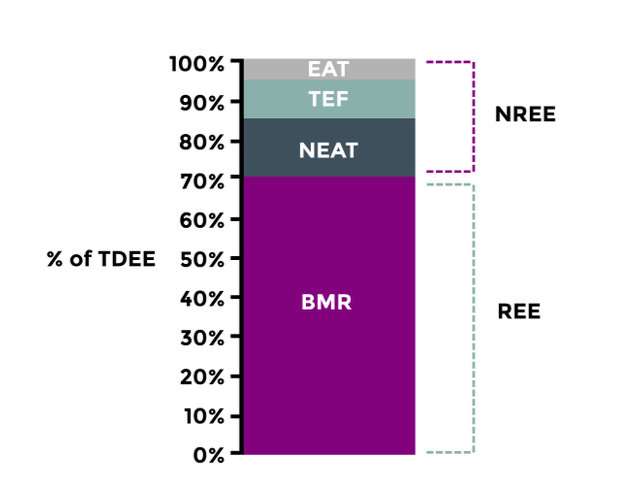
TDEE is the total number of calories your body burns in a 24-hour period. It's divided into four parts: BMR, NEAT, TEF, and EAT. Hang in there with me — I know that's a lot of letters at once.
BMR (Basal Metabolic Rate) — how much energy your body needs just to keep you alive and functioning at complete rest (breathing, heartbeat, etc.)
NEAT (Non-Exercise Activity Thermogenesis) — the energy required for all your movement outside of workouts (walking, fidgeting, talking, etc.)
TEF (Thermic Effect of Food) — it takes energy to digest food, and some foods require more energy to break down than others
EAT (Exercise Activity Thermogenesis) — your actual exercise, and usually the smallest of the four pieces
Why TDEE tells you less than you'd think during marathon training
TDEE gives you a single total number, but marathon training isn't steady-state — a rest day and a 20-mile long run day have wildly different energy demands. TDEE, as one averaged number, can mask serious under-fueling on your hardest training days even if your weekly average looks "fine" on paper.
The energy it actually takes to fuel your workouts and repair your muscles and connective tissue varies a lot from person to person. Two runners can have identical TDEE and completely different outcomes, depending on when and how they eat around their training.
Fueling for training
Hitting your total calories for the day doesn't mean much if the timing is off. As we covered in our last post on marathon weight gain, your body relies heavily on stored glycogen — the carbohydrate stored in your muscles — to fuel long runs and hard efforts. That means when you eat your carbs matters just as much as how many you eat overall.
A runner who saves most of their carbohydrate intake for dinner, but trains fasted or under-fueled in the morning, is running on empty even if their daily total looks completely adequate. Prioritizing carbs around your training — before long runs and hard workouts, not just whenever it's convenient — is what actually determines whether your body has the energy available to perform and adapt.
Fueling for recovery
This is the piece TDEE doesn't capture at all. TDEE is a measure of energy balance — calories in versus calories out — not a measure of tissue repair. You can hit your TDEE precisely and still under-recover, if the timing and composition of your intake doesn't support repair.
Muscle recovery depends heavily on protein — both how much you're eating and when. Getting protein in within the recovery window after a long run or hard workout, and spreading it consistently across the day rather than loading it all at dinner, is what actually helps your muscles rebuild stronger between sessions. A runner can be in perfect caloric balance and still be under-recovering, simply because their protein intake isn't structured to support it.
Practical takeaway
Instead of chasing one perfect calorie number, focus on the framework that actually drives results:
Eat enough overall to support your training volume
Prioritize carbs around your long runs and hard efforts, not just whenever
Prioritize protein consistently across the day, not just at dinner
Pay close attention to your post-run recovery window
If you want a simple way to check whether you're covering these basics, [our Marathon Fueling Checklist] walks through exactly this.
Ready to stop guessing?
If you're not sure when or how much to eat to actually support your training, book a free 15-minute discovery call with me— let's figure out a fueling strategy that works for your body and your training block.
